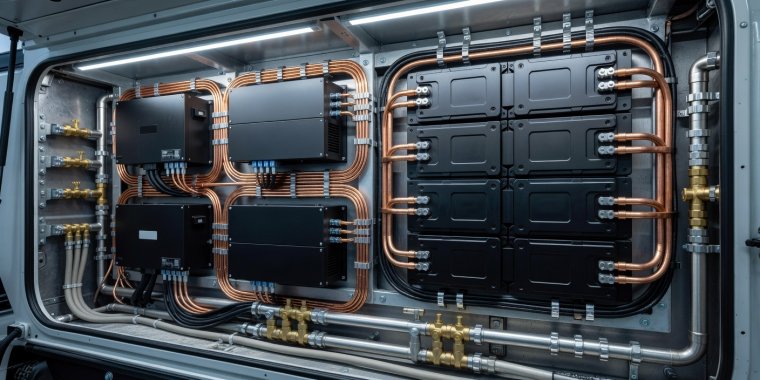
Off-Grid Life Support: Energy & Fluid Autonomy
Circumnavigating remote terrain requires total independence from municipal utility grids. An extreme expedition rig functions as a self-contained ecological pod, continuously producing electrical power, processing raw surface water, and managing complex multi-tank diesel logistics.
Electrical Architecture: 24V/48V High-Capacity DC Buses
Legacy recreational campers typically rely on 12-volt direct current systems. On a heavy expedition truck, a 12V bus is completely impractical: running high-draw induction cooktops, dual air conditioning compressors, and high-pressure water makers would require massive copper cabling that adds hundreds of kilograms of unnecessary dead weight and generates excessive thermal resistance.
Modern expedition platforms utilize a 24-volt or 48-volt secondary DC architecture. High-voltage buses cut conductor cross-sectional requirements by 50% to 75%, allowing clean, high-efficiency power distribution throughout the habitat module.
Energy Storage: Lithium Iron Phosphate (LiFePO4)
Heavy expedition builders exclusively deploy Lithium Iron Phosphate (LiFePO4) chemistry over traditional nickel-manganese-cobalt (NMC) or lead-acid batteries. LiFePO4 offers three critical operational advantages:
- Thermal Stability: LiFePO4 will not enter catastrophic thermal runaway even if physically punctured or subjected to internal short-circuits.
- Deep Discharge Cycling: Capable of delivering 3,500 to 5,000 full cycles at 80% Depth of Discharge (DoD), ensuring over a decade of continuous daily operation.
- Weight Efficiency: Delivers roughly 120 Wh/kg compared to 35 Wh/kg for heavy AGM deep-cycle marine batteries, saving up to 400 kg of payload capacity.
Sub-Zero Charging Defense
Standard lithium cells suffer permanent lithium plating damage if charged below 0°C. To survive sub-Arctic winter crossings, battery banks are installed exclusively inside the climate-controlled living cabin envelope, equipped with internal 24V silicone heating jackets that bring cell core temperatures to +5°C before charging current is permitted by the Battery Management System (BMS).
Multi-Stage Power Generation Triad
Complete autonomy requires three independent power generation sources:
- Secondary Dedicated High-Output Alternator: Mounted directly to the commercial truck diesel engine with dedicated mounting brackets. A secondary 28V 150A or 56V 80A brushless alternator pumps up to 4.5 kW directly into the lithium bank while driving, recharging a drained 15 kWh battery bank in just 3 to 4 hours of highway or trail transit.
- Roof-Mounted Monocrystalline Solar Array: Heavy walk-on solar panels mounted on aluminum rails across the roof provide 1,200W to 2,400W of peak photovoltaic generation. Paired with independent MPPT (Maximum Power Point Tracking) charge controllers for each panel sector to mitigate shade loss from roof racks and antennas.
- Auxiliary Sealed Diesel Generator or Secondary Fuel Cell: As an emergency backup for prolonged periods of dense cloud cover or sub-Arctic blizzards, a silenced commercial diesel generator tied directly to the main fuel system provides on-demand AC charging power.
Water Purification and Fluid Infrastructure
Clean drinking water is the most vital consumable on long-duration expeditions. Vehicles carry dual-tank fresh water systems (typically 400 to 800 litres total capacity) isolated from external freezing hazards within the insulated double-floor basement.
| Purification Stage | Filter Rating / Mechanism | Target Contaminants Removed | Service Interval |
|---|---|---|---|
| Stage 1: Sediment Strainer | 20-micron washable mesh | Coarse sand, river silt, rust flakes, organic debris | Cleaned every 1,000 litres pumped |
| Stage 2: Micro-Filtration | 0.5-micron pleated cartridge | Suspended solids, microscopic cysts, cryptosporidium | Replaced every 5,000 litres |
| Stage 3: Activated Carbon Core | Solid carbon block | Chlorine, agricultural pesticides, bad taste, odors | Replaced every 5,000 litres |
| Stage 4: Ultraviolet Disinfection | High-output 254 nm UV-C chamber | 99.99% of bacteria, viruses, microbial pathogens | Bulb replaced every 9,000 operating hours |
| Stage 5: Reverse Osmosis (Optional) | Semi-permeable TFC membrane | Heavy metals, dissolved salts, brackish minerals | Flushed periodically via permeate backwash |
Multi-Tank Diesel Supply & Fuel Filtration
Severe overland rigs frequently travel through countries where diesel fuel is contaminated with water, sulfur, and particulate dirt. The fuel system relies on dual cross-linked polyethylene or baffled aluminum tanks with motorized balance valves, allowing the driver to isolate fuel supplies if a bad batch of contaminated fuel is taken on.
Before fuel reaches the engine's precision high-pressure common rail injection pump, it passes through dual heated Racor-style water-separator filter bowls equipped with in-cab water detection sensors. In sub-zero environments, electric pre-heaters prevent paraffin wax crystals from clogging the primary filters.
Next Engineering Milestone: Thermal Envelope Technology
Learn how advanced composite panel fabrication and hydronic heating systems maintain comfortable interior temperatures from -45°C to +50°C.
Read Thermal Insulation Guide