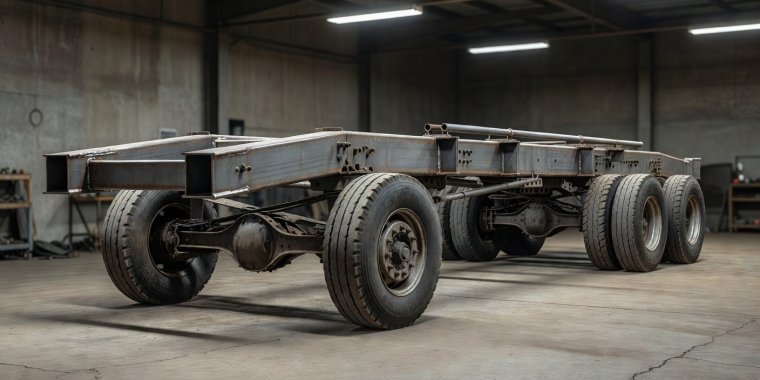
Heavy Chassis Platforms: Selecting the Motive Base
The foundation of every global expedition build begins with the choice of running chassis. Selecting between conventional ladder rails and central backbone tubes dictates drivetrain survival, approach angles, and field serviceability across desolate regions.
Industrial Commercial Origins vs. Military Specifications
Heavy expedition vehicles demand chassis ratings that dwarf standard four-wheel-drive consumer utilities. When carrying 800 litres of diesel fuel, 600 litres of potable water, auxiliary power units, heavy composite bodywork, and tools for long-duration autonomy, total vehicle mass routinely exceeds 14 tonnes. Ordinary commercial delivery trucks will buckle under these dynamic cyclic stresses when subjected to unpaved gravel washboard corridors in Mongolia or the rutted mud tracks of the Congo Basin.
Consequently, serious fabricators rely on severe-duty commercial platforms or demilitarized logistical transport trucks. These platforms feature heat-treated C-channel steel frame rails with high yield strengths (exceeding 500 MPa), planetary hub reduction axles, high ground clearance transfer cases, and pneumatic differential lockers on every axle line.
The Dominant Heavyweight Architectures
Over decades of overland expeditions, four chassis configurations have proven their mechanical survivability:
- MAN TGS / TGM All-Wheel Drive: Known across Eurasia and Africa for robust common-rail diesel engines and widespread availability of industrial fleet spare parts. Features robust parabolic leaf springs or specialized multi-bellow air suspensions.
- Mercedes-Benz Zetros & Arocs: The Zetros utilizes a cab-behind-engine (conventional hood) layout that shifts the driver back behind the front axle. This drastically reduces vertical cabin acceleration over violent bumps and permits easier mechanical field maintenance without tilting the cabin.
- Tatra Phoenix & 815 Series: The unique Czechoslovakian mechanical layout features a rigid central backbone tube housing the driveshafts, paired with independently swinging half-axles. The backbone eliminates torsional chassis twist entirely, transferring ground deflection directly to pneumatic coil dampers.
- Mercedes-Benz Unimog (U4000/U5000): The gold standard for extreme approach angles, portal gear axles, and extreme frame flex. However, its payload capacity (typically capped at 7.5 to 9.5 tonnes) limits habitat shell volume compared to full-size 18-tonne platforms.
Drivetrain Reality: Planetary Hub Reduction
Standard bevel-gear truck axles run their entire reduction ratio inside the central differential pumpkin, requiring massive housings that compromise central ground clearance. Severe-duty expedition trucks utilize hub reduction axles. A smaller central differential distributes torque through high-speed axle shafts to planetary gear sets nested directly inside wheel hubs. This design lifts the differential casing high off the ground, protects half-shafts from extreme torque spikes, and drastically enhances clearance over deep boulder tracks.
Axle Count Comparison: 4x4 vs. 6x6 vs. 8x8
Selecting axle configurations requires trading off maneuverability against ground footprint and payload distribution:
| Configuration | Standard Turning Circle | Typical Wheelbase | Primary Operational Advantage | Inherent Limitation |
|---|---|---|---|---|
| Two-Axle (4x4) | 14.5 to 17.5 metres | 3,600 to 4,200 mm | Compact urban navigation; single spare tire size; lower ferry costs. | Constrained payload ceiling; rear axle load limits water & fuel volume. |
| Three-Axle (6x6) | 18.5 to 22.0 metres | 3,900 mm + 1,400 mm | Extreme flotation on soft dune sand; twin rear axles prevent rear sag. | High scrubbing wear on rear tires; increased driveline complexity. |
| Four-Axle (8x8) | 24.0+ metres | Twin front / twin rear | Massive 30+ tonne capacity; unstoppable momentum across trench ruts. | Restricted access to switchback mountain tracks; massive maintenance load. |
Tire Selection and Central Tire Inflation Systems (CTIS)
Heavy expedition rigs do not run standard radial road tires. They rely on massive 14.00R20 or 16.00R20 military-grade radial tires with aggressive non-directional traction treads. These tires feature multi-ply steel belts capable of sustaining single-wheel loads up to 5,000 kg while withstanding sidewall impacts against sharp shale.
A Central Tire Inflation System (CTIS) represents an indispensable field component. Through rotary pneumatic seals mounted inside the axle spindles, the driver can modulate tire pressure directly from the dashboard while in motion. Highway running pressures of 6.5 bar (95 psi) can be deflated to 1.8 bar (26 psi) when traversing deep dune fields, expanding the tire footprint by more than 200% to float over loose gravel and soft sand.
Next Engineering Milestone: Subframe Kinematics
Discover how extreme chassis frame flex is mechanically isolated from the rigid living habitat through kinematic decoupling.
Read Subframe Mechanics Guide